

“Time is all you have, and you may find one day that you have less than you think.” — Randy Pausch
Time is the only resource we truly own, yet it’s the one we tend to treat as if it were infinite. When I think about time, I find it helpful to frame it in probabilities. Realistically, a lifespan might stretch to around 90 years. That translates to roughly 17,000 sunrises and sunsets.
17,000 days.
The question isn’t whether that’s a lot or a little. The question is: how do you spend them?
One way to look at it is balance—perhaps splitting those days evenly. Maybe 8,500 days for work, and 8,500 for relationships, leisure, and everything else life offers. But that division assumes work is something separate from fulfillment, something to be endured rather than enjoyed.
A more compelling approach is different: dedicate those 8,500 days to work you genuinely love. Work that aligns with your values. Work that feels less like obligation and more like play. When your work becomes an extension of purpose, the boundary between “living” and “working” begins to dissolve.
“Retirement is when you stop sacrificing today for an imaginary tomorrow.” — Naval Ravikant
That idea changes everything.
After reflecting on this, I made a simple but significant shift: I turned off all work notifications. Not because I’ve stopped working, but because I’ve decided to stop engaging in work that no longer brings meaning or joy. Tasks that feel empty should move on—to others who may find opportunity and growth in them.
This decision didn’t come out of nowhere. It’s built on decades of effort—around 10,000 days already invested in building a better future. At some point, continuing to delay fulfillment becomes irrational. Time doesn’t pause. Mortality doesn’t negotiate.
If anything, this shift opens doors for others. There are still 5,000 to 10,000 days waiting for someone else to step in, to build, to grow, to create their own version of tomorrow. There’s dignity in that process—in earning success through effort and persistence.
Looking back, even the hardest, most unpleasant experiences played a role. Digging trenches for concrete blocks under the heat wasn’t glamorous, but it pushed me toward education and better opportunities. Working in a call center, getting shouted at dozens of times a day, wasn’t enjoyable either—but it sharpened my communication skills and taught me resilience under pressure.
These moments weren’t wasted time. They were investments in optionality—the ability to choose a different path later, instead of being trapped in one you dislike.
“You have to suffer, struggle, and endeavor to do hard things to really appreciate what you’ve done.” — Jensen Huang
There’s truth in that. Meaning doesn’t come from ease alone. It’s shaped through challenge, through discomfort, through effort that stretches you beyond what you thought you could handle.
So this isn’t about quitting work. It’s about redefining it.
I’ll continue to work—but on my own terms. I’ll choose projects that align with purpose, that feel meaningful, that contribute to something larger than myself.
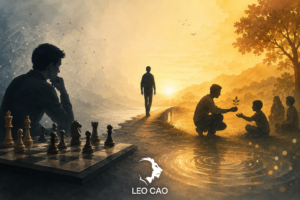
The ancient Greco-Roman idea of life as a progression—the Student, the Warrior, the Senator, the Philosopher—offers a powerful lens. Each stage represents a different way of engaging with the world: learning, striving, leading, and reflecting.
Maybe life isn’t about picking just one role. Maybe it’s about knowing when to step into each of them.
After all, you only get around 17,000 days.
How you spend them is entirely up to you.